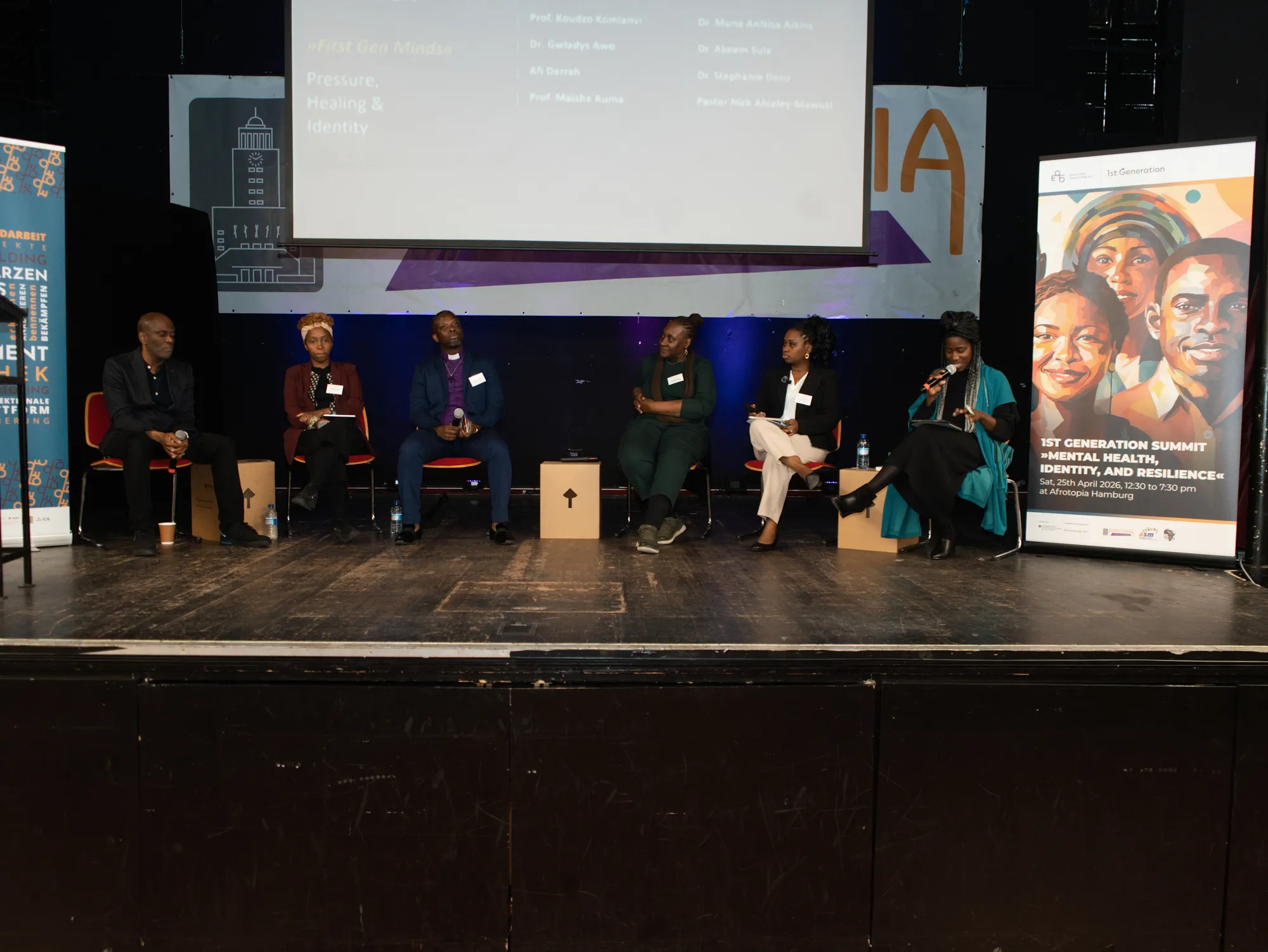
At the heart of the panel was one deceptively simple question: what does it cost a person, a family, and a community to always have to appear strong?
The discussion began with mental health not as an isolated private struggle, but as something shaped by history, migration, racism, family expectation, faith, language, and the pressure to survive in rooms that were never designed with Black people in mind.
“We learn to function in structures, but in rooms that have been made without us in mind.”
Speaking from an educational sciences perspective, one panellist described how people do not only learn useful lessons from society. They also learn harmful ones: how to suppress themselves, how to doubt their own experience, how to fit into institutions that question their belonging. For Black communities and African diasporic communities, this becomes more than discomfort. It can become anxiety, vigilance, and the constant feeling of having to brace for impact.
That idea returned throughout the conversation: strength can be necessary, but when strength becomes the only acceptable posture, it starts to harm the body.
One speaker challenged the familiar lesson many immigrant parents pass down: “You need to work twice as hard.” Coming from a Nigerian background, he named the love and ambition behind that message, but also its damage. Why, he asked, should Black children have to outperform everyone just to receive ordinary treatment?
“Why can’t my kid just work as normal?”
The panel moved from culture into biology. Stress, the speakers explained, is not just a feeling. It activates the body. The nervous system adapts to pressure, but it is not built to live permanently under threat. One panellist described the body as a light that never switches off: morning, evening, work, family, church, school, always on.
“Imagine a light that is always on… that is how it is in your body.”
That image gave the room a shared language for chronic stress. A light that never turns off affects sleep, recovery, mood, blood pressure, and long-term health. In the community, this may show up as burnout, depression, anxiety, hypertension, obesity, type 2 diabetes, and exhaustion that people only recognize once the body has already started to fail.
Another panellist named the quiet inheritance of emotional suppression. Children watch adults hide pain and learn to do the same. Over time, self-suppression becomes embodied.
“Rest is not an option, and slowing down is not an option, not being strong is not an option.”
Faith was treated with both respect and honesty. Pastor Nick pushed back against the idea that depression, anxiety, trauma, or psychological distress should be dismissed as weakness, sin, or lack of faith. He warned against “prayer only” approaches, while also noting that therapy which ignores spirituality, family, and cultural context can fail people too.
“Yes, prayer works. Hallelujah. Our faith works. God works. But I believe God works in a holistic approach.”
The strongest moments came when the panel stopped speaking abstractly. Princess, an audience member working at the intersection of migration and youth, shared how she had been isolated for a month during a difficult period. When she finally attended an African community gathering, someone used what they had overheard about her struggle to mock her as someone with mental problems. “This is supposed to be home,” she said.
That story shifted the room. The question was no longer only whether German systems are failing Black communities. It was also whether Black communities are prepared to hold one another with care.
Pastor Nick responded by saying religious institutions must create room for lament, anxiety, grief, and vulnerability. When challenged about stigma within churches, especially toward autistic children and families dealing with disability or neurodivergence, he was direct:
“The church does more harm than good to people.”
He called for churches to stop moralizing mental health and to stop treating vulnerability as spiritual failure.
The conversation also turned to healthcare access. Stephanie described the difficulty faced by migrants who have lived in Germany for years, pay taxes, raise children, and still cannot find the words in German to explain what they are feeling to a psychologist. The issue is not only whether healthcare exists. It is whether people can actually enter it, be understood, and receive care without discrimination or misdiagnosis.
A project mentioned during the panel, the Diaspora Medical Mobile Clinic, was presented as one response: Black doctors, psychologists, and health professionals who can work across language, culture, and trust.
The panel also made a case for culturally competent therapy. Representation matters, but one speaker argued that it is not only about whether a therapist looks like the patient. It is also about whether they understand the patient’s cultural references, family systems, spiritual life, migration history, and ways of naming distress.
“When language fails, culture speaks.”
That line opened the door to pop culture. Through Hip Hop Psych, Dr. Akim described how rap lyrics, film, and television can become entry points into conversations about trauma, masculinity, stigma, depression, and treatment. Hip hop, he argued, often contains psychological truths long before clinical language arrives. Sometimes people do not say “I am depressed.” They say they are “thinking too much.”
The audience pushed the discussion further. One participant questioned whether “mental health” itself carries stigma and suggested “mental fitness” as a more empowering phrase. Another raised the tension between anti-racist language and positive framing. Dr. Akim’s response was sharp: some harms must be named clearly.
“It’s not our role to make white people feel good about themselves.”
Naming racism, he argued, is not negativity. It is a condition for repair. Without naming the harm, communities are left to carry it silently.
Near the end, Dr. Araba Mwidu, lead of Ghanaian Women in Germany, offered one of the afternoon’s most personal reflections. She spoke about studying, working, hardening herself, “masculinizing” herself, and chasing achievement in the hope of finally being accepted. After all of it, she said, the promise was false. There is no final qualification, title, marriage, career milestone, or sacrifice that makes a person worthy.
“You are enough today and tomorrow we’ll figure it out.”
The panel closed with psychologist and author Evelyn Whitey Ramilla, whose book Where My Name Sounds Different: Lessons from Decades Abroad was introduced to the audience. She spoke of migration not only as movement, but as an emotional rupture: loneliness, family pressure, silence, and what she called migration grief.
“There was always a heaviness.”
The event did not end by pretending the issue had been solved. Instead, it moved into workshops on pop culture and mental health, community healing and family, and anxiety and depression literacy. That felt appropriate. The panel had opened something too large for one stage: the need for language, care, accountability, culturally grounded therapy, spiritually honest communities, and spaces where Black people do not have to perform strength in order to be held.
The lasting message was clear: strength has helped communities survive. But survival cannot be the whole definition of health.